Biography
Dr. Simon Tufts of Medford, older brother of Dr. Cotton Tufts (both children of family no. 11 in Tufts Kinsmen Vol. I), was an ardent Whig and a justice of the peace from 1770. When the fighting began he cared for the wounded on both sides, and he spent the war in the awkward role of guardian to a Loyalist neighbor’s estate.
Service Record
Town: Medford · Dates: [dates not in extract]
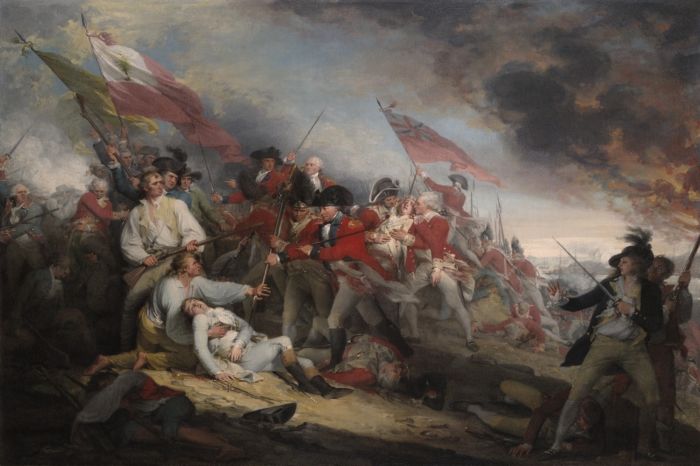
Ardent Whig; justice of the peace 1770; took depositions and bound wounds after Lexington and Concord; attended the wounded on both sides at Bunker Hill; lent bounty money for the war. (Tufts Kinsmen, Vol. I, p. 110, family no. 11-1)
Reluctantly served as conservator of the estate of the Tory Col. Isaac Royall; testified before the Committee of Safety that he believed Royall a friend to the American cause; the Committee refused and ordered the estate surrendered. After Royall’s death in 1781 the state returned the estate to Simon as trustee. (Tufts Kinsmen, Vol. I, p. 110, family no. 11-1)
Fellow of the Massachusetts Medical Society 1782; died from a fall from his horse. (Tufts Kinsmen, Vol. I, p. 110, family no. 11-1)
Family Connection
Family number 11-1 in Tufts Kinsmen, Vol. I. Parents are not named in the extract seen.
Relatives with profiles on this site: father Dr. Simon Tufts (1700–1747); brother Dr. Cotton Tufts; son Simon Tufts (1750–1801), by Lucy Dudley; son Turell Tufts (1770–1842), by Elizabeth Hall.
Spouse(s)
- Lucy Dudley (1727–1768). Married February 23, 1749.
- Elizabeth Hall (1743–1830), daughter of Stephen Hall. Married October 5, 1769. As his widow she married Capt. Duncan Ingraham of Concord, July 12, 1795.
“D R. Simon Tufts , Jr. (1727-1786) married Lucy Dudley (1727-1768), February 23, 1749.”
Eliza M. Gill, “Turell Tufts and His Family Connections,” Medford Historical Register, vol. XVIII (1915), p. 54. Text (Perseus)
“He m., 2d, Elizabeth Hall, Oct. 5, 1769”
Charles Brooks, History of the Town of Medford (1855), Register of Families, p. 546. Page scan · Text (Perseus)
Brooks (p. 546) gives Lucy Dudley’s death as “Nov., 1768, aged 41” but no first marriage date. Find a Grave memorial 26903836 gives both marriages (1749, 1769). Place of marriage not found.
Authoritative IDs / Index Numbers
| Source | ID / status |
|---|---|
| Perseus person index (auth=) | auth=tufts,simon. This is a name-level key shared by every Simon Tufts in Perseus, not a personal ID. Use it with the passages cited on this page. |
| Find a Grave memorial | 26903836 (dates and family checked) |
| Brooks, History of Medford (1855) register no. | No. 23-52, p. 546 |
| Tufts Kinsmen, Vol. I family no. | 11-1 |
| Mass. Soldiers and Sailors | Not yet checked for this page |
| DAR ancestor no. | Note: Pending further work. |
| Adams Papers document IDs | ADMS-01-01-02-0010-0007-0001 and others (see Collections) |
| FamilySearch ID | Note: Pending further work. |
| Geni profile | Note: Pending further work. |
| WikiTree ID | Note: Pending further work. |
| Town / vital records | Brooks’s register (above) is drawn from Medford town and church records; printed VR volume and page not yet checked |
Only IDs confirmed against dates and family are given as matches. “Not yet checked” means the source has not been searched; “Checked, not found” means it was searched without a match.
⚑ Unverified
Birth and death dates are not in the extract. Service was civil and medical, not military. No other source on this site has yet been checked for this man.
Medical Societies: 1765 and the Massachusetts Medical Society
This section concerns Dr. Simon Tufts the younger (1727–1786), not his father, Dr. Simon Tufts (1700–1747).
The 1765 meeting
“he was one of the first in the State who felt the need of a medical society; and he was called to the first meeting for consummating the plan, which meeting took place on the third Monday in March, 1765, at Gardner’s tavern, on Boston Neck.”
Charles Brooks, History of the Town of Medford (1855), p. 306. Text (Perseus)
The plan itself is credited to his younger brother. Philip Cash calls Dr. Cotton Tufts of Weymouth “the prime mover” of the 1765 attempt, which failed (Philip Cash, “The Professionalization of Boston Medicine, 1760–1803,” Medicine in Colonial Massachusetts (Colonial Society of Massachusetts, 1980), n. 33. Online text). So Simon is recorded as a participant called to the meeting, and Cotton as its organizer.
Fellow of the Massachusetts Medical Society, 1782
Medford’s vital records cite his gravestone as “Simon Tufts Esq., F. M. S.,” that is, Fellow of the Medical Society, and his Find a Grave memorial is headed “Dr Simon F.M.S. Tufts Esq.” (memorial 26903836). The fellowship date of 1782 comes from Tufts Kinsmen, Vol. I, p. 110.
⚑ Unverified
The 1782 date of his fellowship has not been confirmed from the Society’s own records.
Pictures



Find a Grave
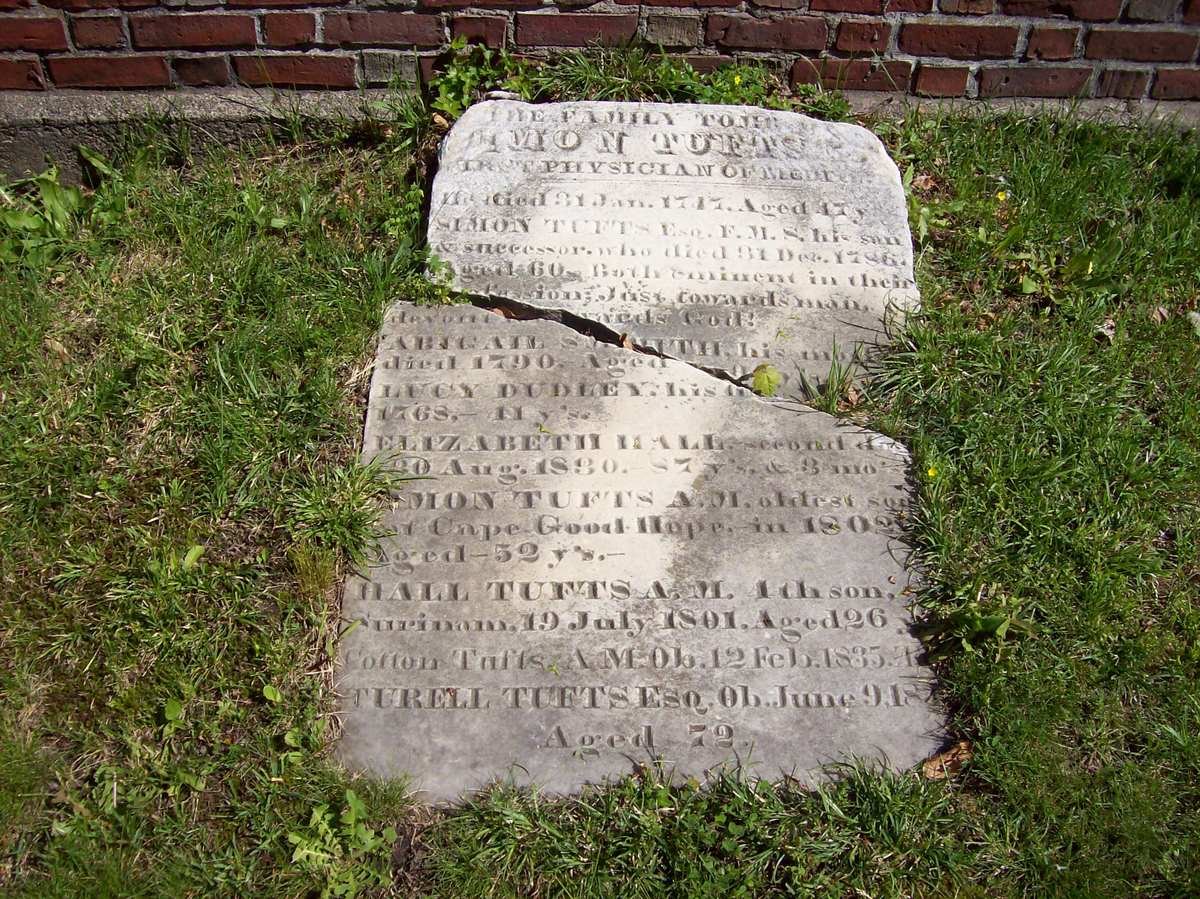
Find a Grave memorial 26903836. As given there (secondary; not checked against original records): Listed as “Dr Simon F.M.S. Tufts Esq.” Born 16 Jan 1726; died 31 Dec 1786. Salem Street Burying Ground, Medford, plot 35 (Tufts family tomb). Parents Dr. Simon Tufts and Abigail Smith; married Lucy Dudley (1749) and Elizabeth Hall (1769); siblings include Dr. Cotton Tufts. His father, Dr. Simon Tufts (1700–1747), has memorial 26903835 in the same plot.
Business
A man of this name appears in Brooks’s History of Medford in connection with the brickyards. Whether it is this man is Unverified. See Businesses.
In the Newspapers
The Boston Gazette of September 3, 1770 lists “Simon Tufts, Esq; to be a Justice of the Peace for the County of Middlesex,” and its issue of June 1, 1772 (p. 2) names “Medford, Simon Tufts, Esq.” among the members returned to the House of Representatives. In May 1773 a Simon Tufts, Esq. was executor of Thomas Seccombe of Medford (p. 4). See Collections.
⚑ Unverified
None of these notices gives his dates; the match to this Dr. Simon is by elimination.
Harvard: Class of 1744
Brooks, p. 305: born Jan. 16, 1727; “graduated at Harvard College in 1744.” He was not the elder Dr. Simon (1700–1747), class of 1724. (Clifford K. Shipton, Sibley’s Harvard Graduates, vol. XI, pp. 478–481 (sketch location from Andrew W. Pollock’s Index of Graduates; sketch text not seen)) See Harvard College.
His Letters
Letters between this Dr. Simon (1727–1786) and the Loyalist Isaac Royall, 1775–1779, are quoted by Brooks (pp. 173–179) and the Medford Historical Register (vol. XI, p. 17). His letters with his brother Cotton are in the Countway Library. See Letters of the Tufts Doctors.
⚑ Unverified
Cause of death. This page’s source says a fall from his horse, and Brooks (p. 306) says a fall brought on bleeding of the lungs. Mary Cranch wrote to Abigail Adams on September 28, 1786 that “Doctor Simon Tufts is just gone in a consumtion” (MHS), and Medford’s church record gives consumption.
His Apprentice, John Brooks
John Brooks (1752–1825), major of minutemen in 1775 and later governor of Massachusetts, was the apprentice of Dr. Simon Tufts the younger (1727–1786). Brooks’s History of Medford says the doctor:
“was so interested in the virtuous character and thirst for knowledge of young John Brooks that he almost adopted him as a son. He took his pupil under a written indenture, as an apprentice for seven years, to learn the science and practice of medicine”
Charles Brooks, History of the Town of Medford (1855), p. 306. Text (Perseus)
Brooks adds that the doctor put him to a classical school, took him into his family, and later invited him back to Medford and “resigned to him his practice.” In 1776 William Tudor wrote to John Adams that Major Brooks “studied Physick with Doctor Tufts of Medford” (Papers of John Adams, vol. 5, pp. 7–9. MHS).
“He was a Medford boy, and only two years before had left the home of Dr. Simon Tufts, where he was educated, to practice medicine in Reading. Probably some of the men had been drilled by him in school-boy days in the vacant lot back of the doctor’s house.”
Medford Historical Register, vol. III, p. 31, on the Medford minute company of April 19, 1775. Perseus
The fullest account is Dr. John Dixwell’s memoir of Brooks, which Charles Brooks quotes in his History of Medford. It describes the apprentice years in the younger doctor’s household, which began when John Brooks was fourteen (about 1766, nearly twenty years after the elder Dr. Simon’s death in 1747):
“In the hours of relaxation from study, he amused himself with the drill and exercise of the soldier. His manners were so gentle and attractive that he was the delight of all the village boys; they collected about him as the chief source of their pleasures and amusements; he formed them into a company, and trained and exercised them in all the duties of military discipline. Dr. Tuft’s yard was often converted into a train-field, and displayed in miniature all ‘the pomp and circumstance of glorious war.’”
Dr. John Dixwell, quoted in Charles Brooks, History of the Town of Medford (1855), p. 128 (the 1886 Usher edition reprints it, pp. 132–133). Internet Archive text
Salem Street Burying Ground
Buried in plot 35 with his father. See Salem Street Burying Ground and its 1930 tablets.
From Cutter’s Memoirs (1910)
“Dr. Tufts took him into his family at the age of fourteen to educate for his profession. He continued with Dr. Tufts until he was twenty-one years old. The doctor then advised him to begin the practice of medicine in the adjoining town of Reading”
Cutter, Genealogical and Personal Memoirs, vol. I, p. 566. Page (Internet Archive)
Cutter’s sketch of Governor John Brooks repeats this account of his apprenticeship to Dr. Tufts of Medford.
Cutter’s Tufts sketch (vol. II, pp. 1198–1200) is a compiled family history of 1910, written for a descendant’s line. Quotes are from the Internet Archive’s scanned text, checked against the printed page numbers.
Source added: William Richard Cutter, ed., Genealogical and Personal Memoirs Relating to the Families of the State of Massachusetts (New York: Lewis Historical Publishing Co., 1910).
Further Details from Additional Sources
“He was carried into Cooper's tavern, then in use as a hospital, and Dr. Simon Tufts of Medford, “a perfect Chesterfield,” at first feared to dress his wounds. Doctors Welch and Spring, however, finally ventured to care for his gun-shot wound and some thirteen bayonet holes.”
Ellen Chase, The Beginnings of the American Revolution (1910), vol. III, p. 147. Page (Internet Archive) (The patient was Samuel Whittemore of Menotomy, wounded on April 19, 1775. Chase cites the Medford Historical Register, October 1898.)
“He was an indented apprentice to Simon Tufts, M. D., at the age of fourteen, until he became of age.”
James Spear Loring, The Hundred Boston Orators (1855 ed.), p. 186. Book scan (Internet Archive) (Of Gov. John Brooks, born at Medford June 6, 1752.)
“September 14th Mr. Samuel Tufts, of Medford, advertised that a basket of crockery ware had been taken up in that town, some time after the battle, which the owner might reclaim.”
Ellen Chase, The Beginnings of the American Revolution (1910), vol. III, p. 268. Page (Internet Archive) (A Medford Samuel Tufts in 1775; which Samuel is not stated.)
Links and Resources
Every source, record, map, survey, marker and artifact tied to this person, gathered in one place. Page numbers are given where a book is cited.
Maps, Surveys and Artifacts
- — The Battle of Bunker’s Hill, June 17, 1775 (Trumbull). A period illustration: John Trumbull’s painting of the battle, 1786. Image: John Trumbull. Public domain. Source: Wikimedia Commons Royall House,
- Source: Wikimedia Commons — The Battle of Bunker’s Hill, June 17, 1775 (Trumbull). A period illustration: John Trumbull’s painting of the battle, 1786.Image: John Trumbull. Public domain.
- — The Battle of Bunker’s Hill, June 17, 1775 (Trumbull). A period illustration: John Trumbull’s painting of the battle, 1786.Image: John Trumbull. Public domain. Source: Wikimedia Commons
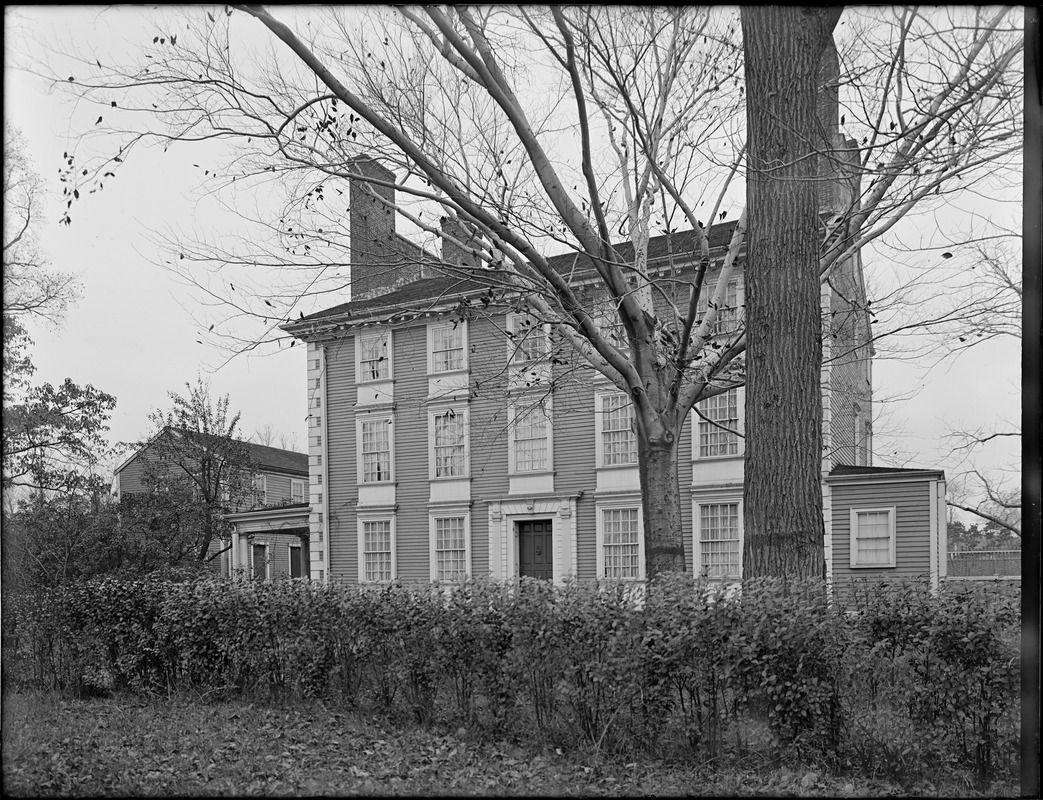
- Source: Wikimedia Commons — …Loyalist Col. Isaac Royall. Tufts association: Peter Tufts (b. 1753) settled early on “the Royal farm in Medford” (Booth, Historic Leaves vol. 1, p. 22).Image: Leon H. Abdalian (via Boston Public Library / DPLA). Public domain.
- — …Tufts association: Peter Tufts (b. 1753) settled early on “the Royal farm in Medford” (Booth, Historic Leaves vol. 1, p. 22).Image: Leon H. Abdalian (via Boston Public Library / DPLA). Public domain. Source: Wikimedia Commons
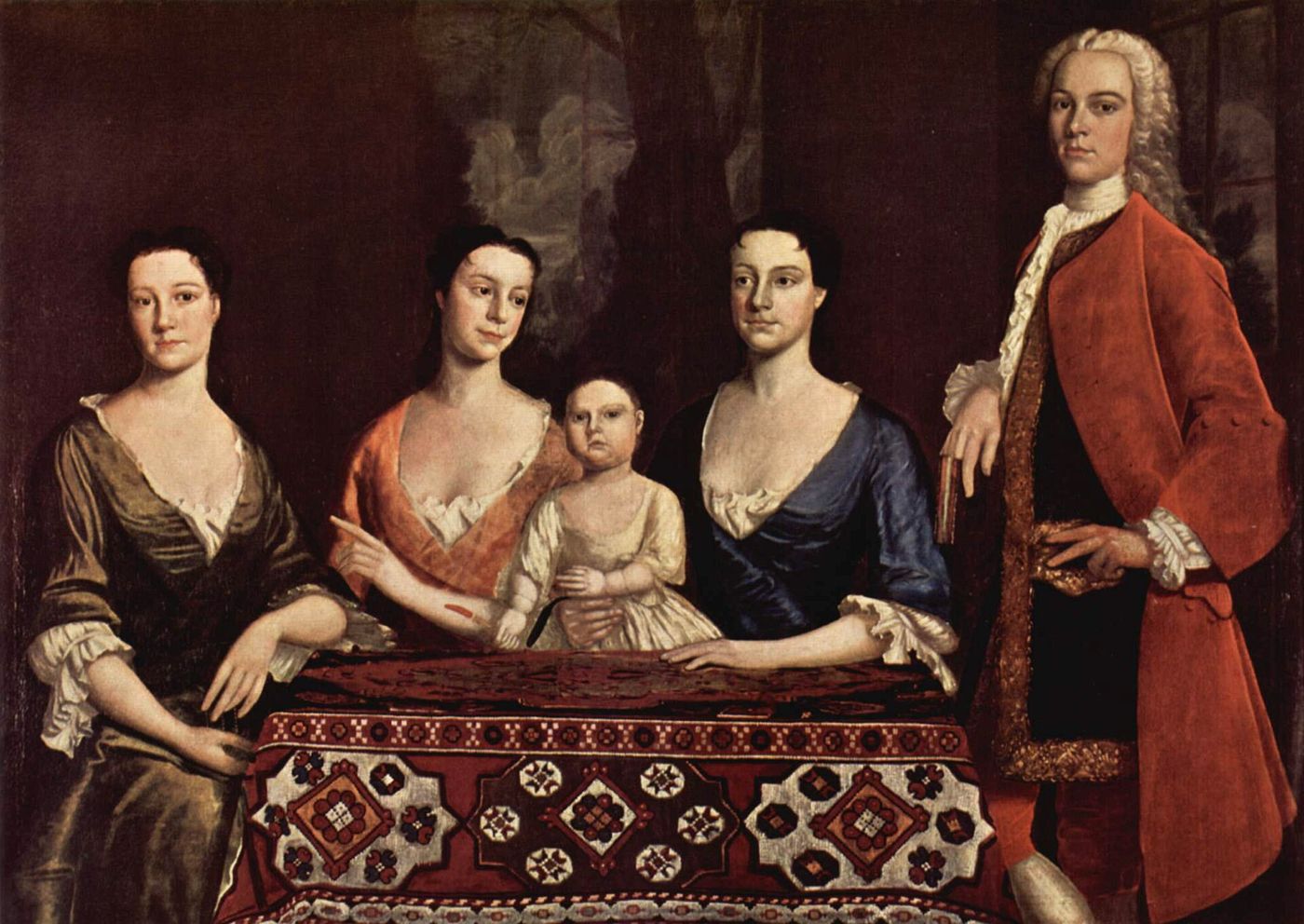
- Source: Wikimedia Commons — …Royall Jr. with his wife, sister, sister-in-law, and daughter, 1741, Harvard Law School. Tufts association: Peter Tufts (b. 1753) settled early on “the Royal farm in Medford” (Booth, p. 22).Image: Robert Feke. Public domain.
- — Tufts family tomb slab, Salem Street Burying Ground, Medford. The family tomb (plot 35). The same photograph appears on the memorials of Dr. Simon Tufts (1726–1786) and his father Dr. Simon Tufts (170
- Collections — …of Middlesex,” and its issue of June 1, 1772 (p. 2) names “Medford, Simon Tufts, Esq.” among the members returned to the House of Representatives. In May 1773 a Simon Tufts, Esq. was executor of Thomas Seccombe of Medford (p. 4).
- Letters of the Tufts Doctors — …this Dr. Simon (1727–1786) and the Loyalist Isaac Royall, 1775–1779, are quoted by Brooks (pp. 173–179) and the Medford Historical Register (vol. XI, p. 17). His letters with his brother Cotton are in the Countway Library.
Graves and Memorials
- Find a Grave memorial · 26903836
- …Medford, plot 35 (Tufts family tomb). Parents Dr. Simon Tufts and Abigail Smith; married Lucy Dudley (1749) and Elizabeth Hall (1769); siblings include Dr. Cotton Tufts. His father, Dr. Simon Tufts (1700–1747), has memorial · 26903835
- Salem Street Burying Ground — Buried in plot 35 with his father.
Markers, Plaques and Places
- Businesses — A man of this name appears in Brooks’s History of Medford in connection with the brickyards. Whether it is this man is Unverified.
- Harvard College — …in 1744.” He was not the elder Dr. Simon (1700–1747), class of 1724. (Clifford K. Shipton, Sibley’s Harvard Graduates, vol. XI, pp. 478–481 (sketch location from Andrew W. Pollock’s Index of Graduates; sketch text not seen))
Digitized Books and Journals
- Eliza M. Gill, “Turell Tufts and His Family Connections,” Medford Historical Register, vol. XVIII (1915), p. 54. · Text (Perseus)
- Charles Brooks, History of the Town of Medford (1855), Register of Families, p. 546. · Page scan
- Charles Brooks, History of the Town of Medford (1855), Register of Families, p. 546. · Text (Perseus)
- Charles Brooks, History of the Town of Medford (1855), p. 306. · Text (Perseus)
- Index of Graduates — …Jan. 16, 1727; “graduated at Harvard College in 1744.” He was not the elder Dr. Simon (1700–1747), class of 1724. (Clifford K. Shipton, Sibley’s Harvard Graduates, vol. XI, pp. 478–481 (sketch location from Andrew W. Pollock’s
- Medford Historical Register, vol. III, p. 31, on the Medford minute company of April 19, 1775. · Perseus
- Dr. John Dixwell, quoted in Charles Brooks, History of the Town of Medford (1855), p. 128 (the 1886 Usher edition reprints it, pp. 132–133). · Internet Archive text
- Cutter, Genealogical and Personal Memoirs, vol. I, p. 566. · Page (Internet Archive)
- Ellen Chase, The Beginnings of the American Revolution (1910), vol. III, p. 147. · Page (Internet Archive)
- James Spear Loring, The Hundred Boston Orators (1855 ed.), p. 186. · Book scan (Internet Archive)
- Ellen Chase, The Beginnings of the American Revolution (1910), vol. III, p. 268. · Page (Internet Archive)
Archives, Letters and Records
- …This page’s source says a fall from his horse, and Brooks (p. 306) says a fall brought on bleeding of the lungs. Mary Cranch wrote to Abigail Adams on September 28, 1786 that “Doctor Simon Tufts is just gone in a consumtion” · MHS
- …family, and later invited him back to Medford and “resigned to him his practice.” In 1776 William Tudor wrote to John Adams that Major Brooks “studied Physick with Doctor Tufts of Medford” (Papers of John Adams, vol. 5, pp. 7–9. · MHS
Other Resources
- …Tufts of Weymouth “the prime mover” of the 1765 attempt, which failed (Philip Cash, “The Professionalization of Boston Medicine, 1760–1803,” Medicine in Colonial Massachusetts (Colonial Society of Massachusetts, 1980), n. 33. · Online text