A Shield from Across the Sea
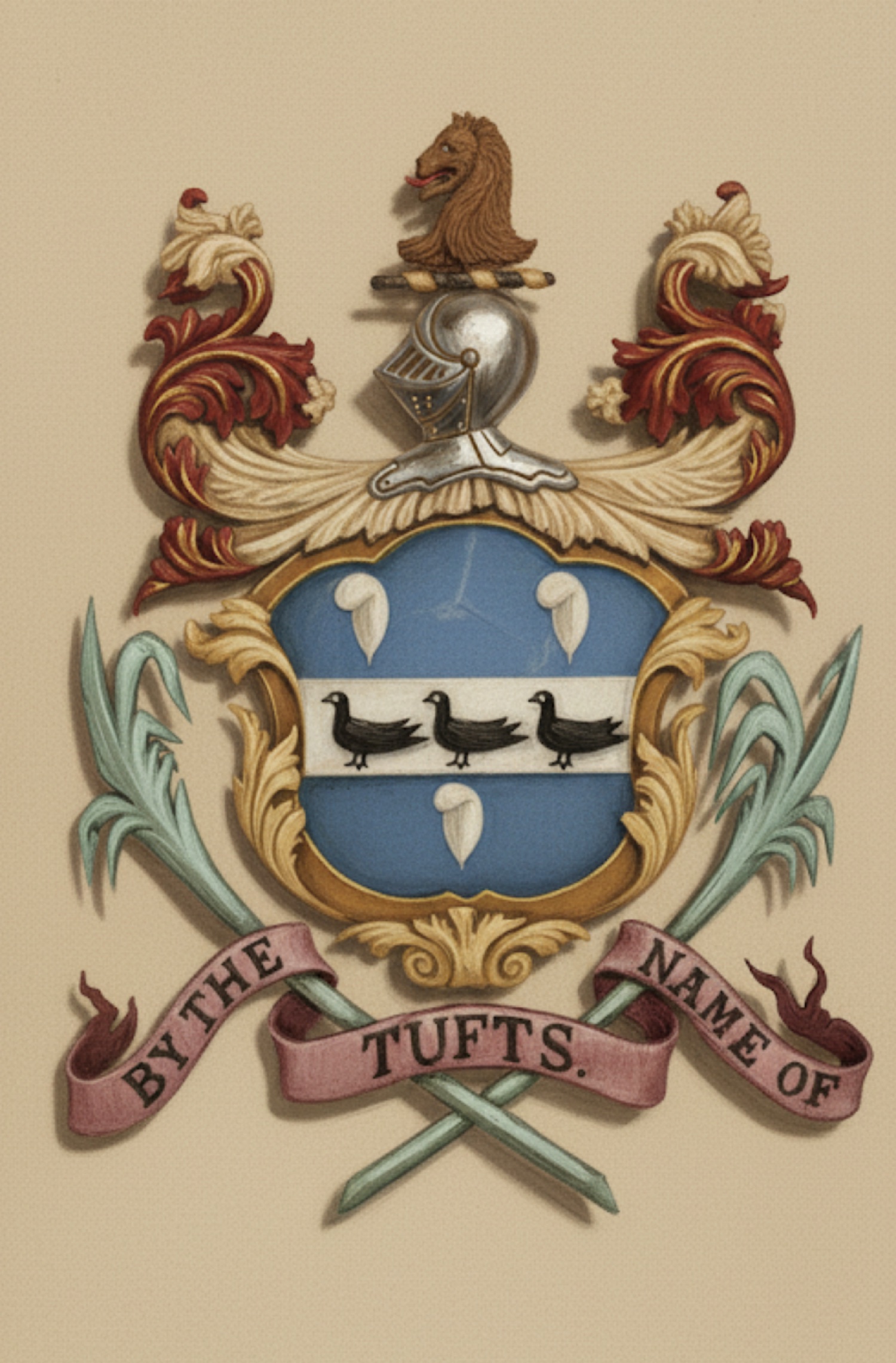
Many New England families of the late eighteenth and early nineteenth centuries hung a painted or embroidered coat of arms in the parlor, lettered beneath with the words “By the Name of” and the family surname. The Tufts family was no exception. The design that has come down under the Tufts name, though, a shield from across the sea. Its shield matches the coat of Tufnell of England. This page sets out what the records show about that shield, where the American custom came from, and the other arms that have been linked to the name.
The Design
Original armorial painting
An image of the original painting on which the reproduction is based will be added here. Its maker, date, owner and present location have not yet been identified.
Note: Pending further work.
The achievement, as shown in the reproduction, has these parts:
- Shield: blue (azure), crossed by a broad white horizontal band (a fess argent) bearing three black birds (martlets sable). There are three white ostrich feathers on the blue, two above the band and one below.
- Helmet and mantling: a steel helmet in profile above the shield, with leafy mantling in red, gold and cream on either side.
- Crest: a brown animal’s head, lion-like, rising from a twisted wreath of gold and blue on the helmet.
- Behind the shield: two crossed green sprays or feathers.
- Ribbon: a pink scroll lettered “BY THE NAME OF TUFTS.”
The Tufnell Arms
The shield matches, charge for charge and colour for colour, the arms that Burke’s General Armory records for the Tufnell family of Langleys, Essex:
“Tufnell (Langleys, co. Essex; descended from Richard Tufnaile, or Tufnell, citizen and brewer of London, M.P. for Southwark in 1640. John Jolliffe Tufnell, Esq., of Langleys, was High Sheriff co. Essex 1823). Az. on a fess betw. three ostrich feathers ar. as many martlets sa. Crest—A dexter arm embowed in armour ppr. holding in the gauntlet a cutlass ar. hilt or.”
Sir Bernard Burke, The General Armory of England, Scotland, Ireland, and Wales (London, 1884), p. 1035. Book scan (Internet Archive) (Scanned text; obvious scanning errors corrected.)
In plain words: a blue shield; a silver band between three silver ostrich feathers; on the band, three black martlets. Burke gives the Tufnell crest as an arm in armour, bent at the elbow, holding a cutlass. The animal-head crest in the American painting is therefore not the Tufnell crest. It may be the painter’s choice or a crest taken from another source. Its source has not been identified.
Burke has no entry at all under “Tufts.” The neighbouring entries on the same page are for unrelated names: Tuffle (“Gu. six ostrich feathers ar.”) and the Tufton Earls of Thanet (“Sa. an eagle displ. erm. a border ar.”) (Burke, pp. 1035–36).
The Toft Arms
A second set of English arms often linked to the name belongs to families called Toft or Tofte. Burke’s General Armory gives three entries together:
“Toft, or Tofte. Ar. a chev. betw. three crosses formee fitchee sa. (another, crosses gu.). Crest—A phoenix ppr. Toft (Toft, co. Chester). Ar. three Saxon text C’s sa. Tofte. Gu. three garbs ar. banded or.”
Sir Bernard Burke, The General Armory of England, Scotland, Ireland, and Wales (London, 1884), p. 1017. Book scan (Internet Archive) (Scanned text; obvious scanning errors corrected.)
- Toft or Tofte: a silver shield with a black chevron between three black crosses formée fitchée (crosses with splayed arms and a pointed foot). Burke notes a variant with the crosses red. The crest is a phoenix. Papworth’s Ordinary lists the same shield (“Arg. a chev. betw. three crosses patty fitchy sa.”) under “Tofte or Toft” among several other families, Finderne and Bromhall among them (J. W. Papworth and A. W. Morant, An Alphabetical Dictionary of Coats of Arms, London, 1874, vol. I, pp. 410–11. Book scan (Internet Archive)). Fairbairn gives the crest as “Toft or Tofte, a phoenix in flames ppr.” (Fairbairn’s Book of Crests of the Families of Great Britain and Ireland, Edinburgh and London, 1905 ed., vol. I, p. 552. Book scan (Internet Archive)).
- Toft of Toft, Cheshire: silver, with three black Gothic (“Saxon text”) letters. Burke’s scanned text reads the letter as C. Burke gives the arms of a Holford family as “Ar. a chev. betw. three text Ts (old English characters) sa.” (Burke, p. 499). The Holfords of Holford, Cheshire, are given a different coat, a black greyhound on silver (p. 498). That the Holford arms with text Ts came from a Toft heiress, and that Toft of Toft bore three text Ts, comes from Sir Peter Leycester’s Historical Antiquities (1673) (source not yet confirmed). Leycester’s book records the Toft family and its lands at Toft and Bexton, and later the Leycesters of Toft Hall, but the scanned text did not show the arms.
- Tofte: red, with three silver sheaves of wheat (garbs) banded in gold (Burke, p. 1017). Burke gives these arms to “Tofte” alone. No printed source found so far gives them to Tufts. Variants with crescents have not been found in Burke, Papworth or Fairbairn (source not yet confirmed).
Burke, Papworth and Fairbairn have no separate entry for Tofts, Tuffts or Tufts. Fairbairn lists the Tufnell family, but under its crest only.
What these arms do and do not show
In English heraldry a coat of arms belongs to the person it was granted or confirmed to, and to that person’s proven descendants in the male line, not to everyone who shares a surname. The Tufts family of this site descends from Peter Tufts, said in family accounts to have come from Norfolk (source not yet confirmed), who settled at Charlestown and Malden by the 1640s. No record has been found that connects him to the Toft families of Toft Hall in Cheshire or to any other armigerous Toft line, and no grant of arms to his family is known. The Toft arms are shown here because the names are often confused, not as arms of the Tufts family. Commercial “family crest” sites often present invented or mismatched designs under the Tufts name. The surnames Tufnell and Tufts have separate origins, and no heraldic link between the two families is documented. The use of the Tufnell shield on the Tufts painting and needlework reflects the New England custom described above.
No freely licensed historical image of the Toft arms has been found, and none of the early books above illustrates the shields. The plain shields below stand in for the arms, which are described in the captions from Burke.
“By the Name of”: The American Custom
Very few colonial families held a grant of arms from the English College of Arms, but arms still carried prestige. Historic Deerfield’s catalogue explains how families chose them:
“Although few American families were conferred arms by the English College of Heralds, the aristocratic connotation was no less meaningful to established families in New England; they did not hesitate to select arms of people with common surnames. By 1730, Boston heraldic painters had access to a number of publications that illustrated coats of arms from which to copy or combine elements.”
Historic Deerfield, “needlework coat of arms: Tufts,” ca. 1800, Hartford, Conn., accession no. HD 1998. Museum record (Five College Museums)
Boston painters made many of these pictures. Historic Deerfield holds several watercolours lettered “By the Name of” that it attributes to John Coles Sr. or his son John Coles Jr., among them Putnam, Jones and Hurd, all dated about 1800 (Historic Deerfield, “Coat of Arms: By the Name of Putnam,” possibly John Coles Sr. or John Coles Jr., ca. 1800, accession no. HD 2019.16. Museum record; see also “By the Name of Jones” (HD 2431.1) and “By the Name of Hurd” (HD 2431.2), same attribution.). The Tufts painting fits this pattern: an English shield found in a book under a similar name, a helmet and mantling, and the surname on a ribbon. No Coles painting for Tufts has been found.
The “Tuffts Family” Embroidery at Historic Deerfield
The only Tufts coat of arms in a museum found so far is a needlework piece at Historic Deerfield, catalogued as “needlework coat of arms: Tufts,” ca. 1800, made in Hartford, Connecticut. It is polychrome silk embroidery on a white satin silk ground, accession number HD 1998. The museum describes it as an “Embroidered silk coat-of-arms of the Tuffts Family” (Historic Deerfield, “needlework coat of arms: Tufts,” ca. 1800, Hartford, Conn., accession no. HD 1998. Museum record (Five College Museums)).
“Heraldic embroidery provided the perfect forum for displaying needlework, education, leisure, status, and family allegiance.”
Historic Deerfield, “needlework coat of arms: Tufts,” ca. 1800, Hartford, Conn., accession no. HD 1998. Museum record (Five College Museums)
View the needlework at Historic Deerfield
needlework coat of arms: Tufts
Maker: not recorded
Hartford, Connecticut, ca. 1800
Polychrome silk embroidery on white satin-weave silk
Historic Deerfield, accession no. HD 1998
The museum record lists no maker, and as of November 4, 2026 its online page shows no photograph and does not describe the shield. A photograph of the piece shared with the family shows that it carries the same shield as the painting: a pale blue field and a white fess bearing three birds, between three feathers, two above and one below. It also has a lion-like head for a crest above a helmet, leafy mantling, two crossed green sprays, and a ribbon lettered “BY THE NAME OF TUFTS.” In the silk the birds are worked in blue and the feathers in dark brown. So at least one Tufts household of about 1800 displayed the Tufnell shield under its own name. No grant of these arms to a Tufts, and no genealogical link between the Tufts and Tufnell families, is documented. Under the Five College Museums’ terms, posting a collection image on a website counts as publication and needs the museum’s permission, so no image is copied here. Rights requests go to Historic Deerfield’s Digital Assets Coordinator.
What the American Armories Record
Bolton’s American Armory (1927) lists arms actually used in America, from seals, gravestones, bookplates and silver. It has no entry for Tufts. Its entries pass from Tufton to Tuite (p. 167). The Tufton entry is the seal of John Tufton, Sheriff of New Hampshire, on a document of August 1688. Tufton is a different family from the Charlestown and Medford Tufts.
The name does turn up in Bolton under other families’ arms. The Norton arms were “Engr. on tankard given by Mrs. Elizabeth Quincy, daughter of Rev. John Norton of Hingham, Mass., to her daughter, Lucy Tufts. In First Ch. Quincy, Mass.” (Bolton, Norton entry, pp. 118–124). Lucy (Quincy) Tufts was the first wife of Dr. Cotton Tufts. Bolton also records a framed watercolour of the Whitney arms by Mrs. Mary Lovering Holman, “Owned by Mrs. Susan Cotton Tufts, Brookline, Mass.” (Bolton, p. 180).
Crozier’s General Armory (1904), a registry of American families “entitled to coat armor,” has no Tufts entry either (William Armstrong Crozier, Crozier’s General Armory: A Registry of American Families Entitled to Coat Armor (New York, 1904). Book scan (Internet Archive); searched in the full text).
Tufts College: Seal and Coat of Arms
Tufts College, named for Charles Tufts, who gave its hilltop land, has its own heraldry. It has nothing to do with the family painting. The trustees adopted the college seal on July 17, 1857. It shows a dove with an olive branch flying down toward an open Bible on a rocky height, with the motto “Pax et Lux” (“Peace and Light”) (Anne Sauer et al., Concise Encyclopedia of Tufts History (Tufts University, 2000), “College Seal, 1857.” Text (Tufts Digital Library)).
In 1939 President Leonard Carmichael introduced a separate coat of arms for everyday use, designed by Maurice Biscoe of the architects Andrews, Jones, Biscoe and Whitmore. It was a blue shield quartered with the sun, two books and the descending dove, with the motto on a ribbon. Brown, one of the college colours, was left out “because brown was not an appropriate color in heraldry.” The arms were dropped in the mid-1960s, and an updated seal reading “Sigillum Universitatis Tuftensis” was adopted in 1966 (Anne Sauer et al., Concise Encyclopedia of Tufts History (Tufts University, 2000), “Coat of Arms, 1939-66.” Text (Tufts Digital Library)).
Commercial “Tufts Crest” Claims
Several online shops sell a “Tufts family crest” on rings, prints and mugs, among them crestsandarms.com and heraldicjewelry.com. They give no source for the arms they show, and some show designs unlike the painting. These are commercial claims. They are not evidence that any Tufts was granted arms, and they are not used as sources on this site.
In Short
The “By the Name of Tufts” arms are a piece of American family art. The shield is the Tufnell coat as recorded by Burke, used for the Tufts name in keeping with the New England custom of displaying arms of a family with a similar surname. No grant of arms to anyone named Tufts has been found in Burke, Bolton or Crozier. The arms are still part of the family’s story. They show how a Charlestown and Medford family of farmers, doctors and tradesmen chose to present itself around 1800.
Verification To-Do
Shannon Tufts is following up on these items to confirm the details on this page.
- Contact Historic Deerfield (Lauren D. Whitley, lwhitley@historic-deerfield.org) for permission to show the needlework coat of arms (HD 1998) on this site.
- Locate the original “By the Name of Tufts” painting and identify its maker, date, owner and present location.
- Confirm whether John Coles Sr. or John Coles Jr. painted the Tufts arms, and verify their life dates.
- Check the source for the Tufnell arms at Monken Hadley, Middlesex, and their use from about 1613, in Papworth’s Ordinary and the heralds’ visitations.
- Identify who made the Deerfield needlework and which Tufts household it was made for.
- Identify the source of the animal-head crest.
- Find the exact page of the Norton entry in Bolton’s American Armory (pp. 118–124).
- Confirm in Sir Peter Leycester’s Historical Antiquities (1673) the arms of Toft of Toft (three text Ts) and of Holford descended from the Toft heiress, with page numbers.
- Check the page image of Burke, p. 1017, to see whether the Toft of Toft letters are Cs or Ts.
- Find any printed source for the garbs coat or a crescent variant attributed to Tufts.
- Check the New England Historic Genealogical Society Committee on Heraldry’s Roll of Arms for Tufts.